
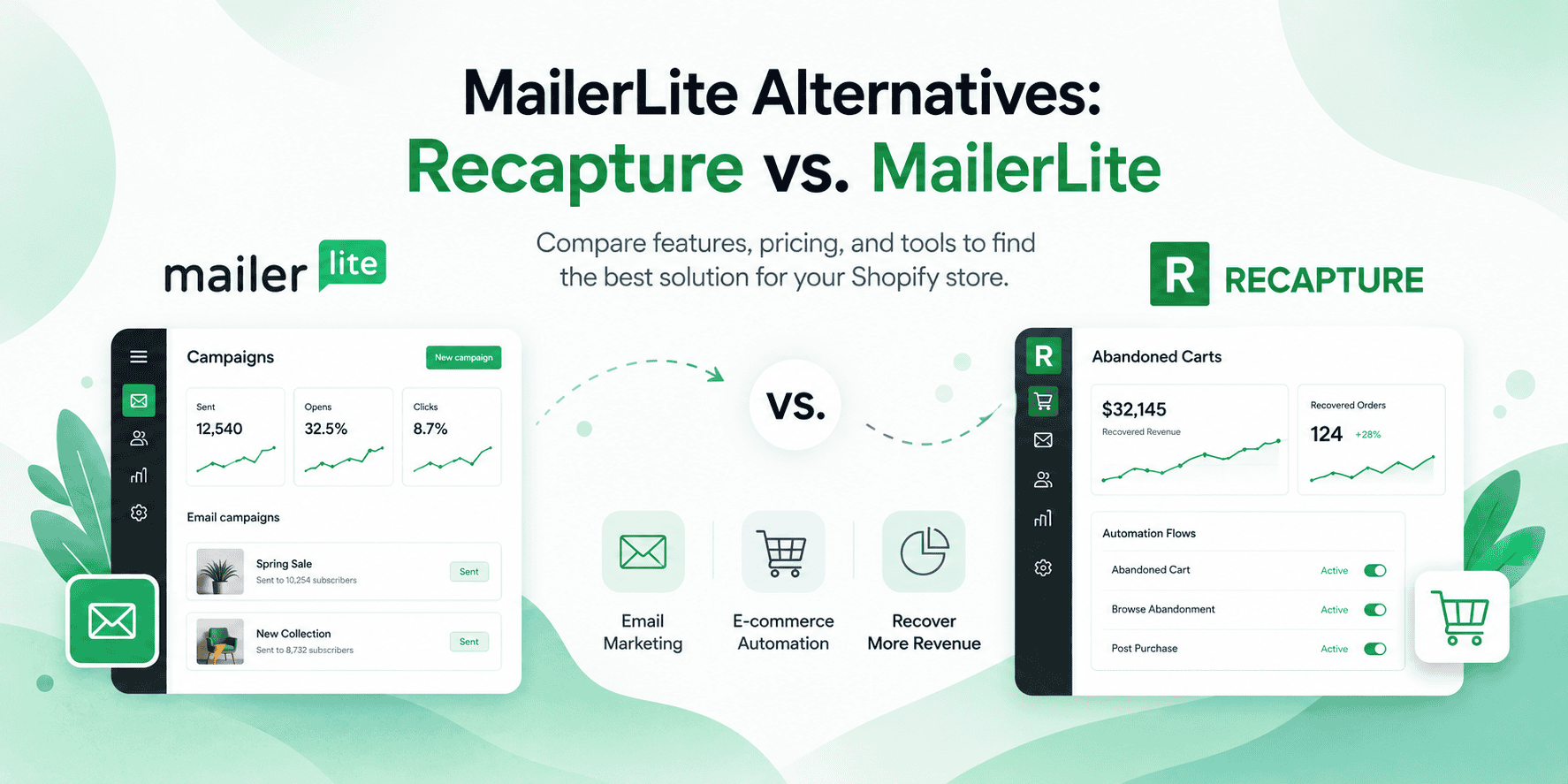
TL;DR: MailerLite is a solid email tool for newsletters and creators, but its ecommerce integration is thin. The Shopify app sits at 2.6 stars with 57% of reviews at 1 star. The best alternatives for ecommerce stores in 2026 are Recapture (cart recovery), Klaviyo (advanced segmentation), Omnisend (email and SMS together), and Brevo (budget multi-channel). Full comparison and pricing below.
If your store has outgrown MailerLite, you are not alone. MailerLite is well-built for bloggers, creators, and newsletter senders. Ecommerce stores hit the limits fast. Abandoned cart recovery is thin. Reporting is subscriber-focused, not revenue-focused. SMS is not available at all. The Shopify integration has well-documented problems.
Below are 10 alternatives worth weighing for an ecommerce store in 2026, with honest notes on where each one fits best.
How I evaluated these alternatives
I run Recapture, which makes me a competitor to MailerLite. To keep this fair, I held every tool to the same standard. Each one is evaluated on ecommerce fit, pricing model, Shopify integration quality (rating and review themes), and which kind of store gets the most from it. Where MailerLite is still the right pick, I say so.
The 10 best MailerLite alternatives at a glance
| # | Tool | Best for | Starting price | Shopify rating |
|---|---|---|---|---|
| 1 | Recapture | Ecommerce cart recovery and post-purchase | $39/mo (15-day free trial) | 5.0★ (36 reviews) |
| 2 | Klaviyo | Advanced segmentation, $1M+ stores | Free / $20/mo | 4.6★ |
| 3 | Omnisend | Email and SMS in one platform | Free / $16/mo | 4.7★ |
| 4 | Brevo (formerly Sendinblue) | Budget multi-channel | Free / $9/mo | 4.4★ |
| 5 | Shopify Email | Native Shopify simplicity | Free for 10K emails/mo | 4.5★ |
| 6 | Mailchimp | Familiar editor, generalist | Free / $13/mo | 3.4★ |
| 7 | Kit (formerly ConvertKit) | Creators and digital product sellers | Free / $9/mo | 4.5★ |
| 8 | ActiveCampaign | Deep automation, has a marketer on staff | $15/mo | 4.5★ |
| 9 | Sender | MailerLite-style UX at lower price | Free / $15/mo | 4.4★ |
| 10 | AWeber | Long-time email senders | Free / $15/mo | 4.5★ |
1. Recapture (Best for ecommerce cart recovery)
Best for: Founder-run ecommerce stores doing $500K to $20M in revenue that want abandoned cart recovery, post-purchase emails, and SMS without the complexity of running a full marketing platform.
I built Recapture for ecommerce from day one. Since 2015, we’ve helped 11,000 stores recover over $340 million in lost sales. The product is focused: abandoned cart recovery, post-purchase emails, winback, browse abandonment, SMS, and email broadcasts. Setup takes about 5 minutes. AI generates your first recovery campaign in under 60 seconds.
The philosophy is different from MailerLite. MailerLite gives you a toolkit and expects you to build your own workflows. Recapture gives you pre-built campaigns based on data from 11,000 stores. You turn them on, and they work.
Where Recapture excels
Abandoned cart recovery is Recapture’s core product, not a feature buried in a menu. You get multi-step email sequences with full timing control, cart value segmentation, and an email capture popup that triggers on add-to-cart. The popup catches shoppers before they reach checkout. MailerLite cannot do that.
Recapture also includes SMS for cart recovery, order notifications, winback, and post-purchase texts. Reporting is revenue-focused. You see dollars recovered, revenue per email, conversion rates, and customer lifetime value. Not just open rates.
Support is a real differentiator. Every one of Recapture’s 36 Shopify reviews is 5 stars. The most common theme across them is how fast and personally the team responds. I respond directly, often within hours. MailerLite merchants report waiting weeks.
Recapture supports Shopify, WooCommerce, BigCommerce, Magento, and Easy Digital Downloads. If you sell on multiple platforms, one tool covers all of them.
Where Recapture is more limited
Recapture is not a general-purpose email marketing platform. There is no website builder, no landing page creator, and no blog tool. If you need those things, MailerLite or a dedicated platform is the right choice.
Recapture’s automation covers the most common ecommerce triggers: abandoned cart, post-purchase, winback, browse abandonment. If you need 50 segment rules and deeply custom flow logic, Klaviyo is still the power tool for that job.
The starting price of $39 per month is also higher than MailerLite’s entry point. Recapture’s pricing scales with recovered revenue, so cost grows with results. The 15-day free trial requires no credit card.
MailerLite vs Recapture: side-by-side
| Feature | MailerLite | Recapture |
|---|---|---|
| Best for | Newsletters, blogs, creators | Ecommerce cart recovery |
| Abandoned cart emails | Basic (via Shopify/WooCommerce integration) | Multi-step with AI setup, timing control |
| Post-purchase emails | Manual workflow setup | Built-in (welcome, upsell, review, winback) |
| SMS | No | Yes (cart recovery, order notifications, winback) |
| Email capture popups | Yes (generic forms) | Yes (add-to-cart triggered, ecommerce-specific) |
| Website builder | Yes | No |
| Landing pages | Yes | No |
| Newsletter broadcasts | Yes (core feature) | Yes (on Email plan) |
| Automation complexity | Visual workflow builder, moderate learning curve | Pre-built campaigns, 5-minute setup |
| Ecommerce reporting | Subscriber-focused metrics | Revenue per email, recovery rate, LTV tracking |
| Platforms supported | Shopify, WooCommerce, BigCommerce, plus 140 integrations | Shopify, WooCommerce, BigCommerce, Magento, EDD |
| Starting price | Free (500 subscribers) / $10/mo paid | $39/mo (15-day free trial) |
| Support | Email and chat (paid tiers only for 24/7) | Live chat, email, phone, founder responds directly |
| Shopify rating | 2.6★ (30 reviews, 57% are 1-star) | 5.0★ (36 reviews, 100% are 5-star) |
Pricing: MailerLite vs Recapture
| Plan | MailerLite | Recapture |
|---|---|---|
| Free tier | Yes (500 subscribers, 12K emails/mo) | 15-day full-feature trial (no credit card) |
| Entry paid plan | $10/mo (Growing Business, 500 subs) | $39/mo (Cart Recovery) |
| Mid-range | $20/mo (Advanced, 500 subs) | $58/mo (Cart Recovery + Broadcasts) |
| At 5,000 subscribers / $50K in cart sales | $39/mo (Growing) or $59/mo (Advanced) | $59/mo (based on ~$5K recovered) |
| At 50,000 subscribers / $200K in cart sales | $289/mo (Growing) or $339/mo (Advanced) | $299/mo (based on ~$20K recovered) |
| SMS included? | No | Yes (add-on starting at $20/mo) |
| Pricing model | Per subscriber count | Per recovered revenue |
The pricing models work differently. MailerLite charges based on how many subscribers you have, whether or not you email them. Your bill grows with your list. Recapture charges based on recovered revenue. Cost scales with results.
At small scales, MailerLite is cheaper on paper. Add SMS, a cart recovery app, and the time spent building workflows manually, and the total cost of ownership often evens out.
Start a 15-day Recapture trial (no credit card)
2. Klaviyo (Best for advanced segmentation)
Best for: Shopify stores doing $1M+ in revenue with a dedicated marketer who needs deep behavioral segmentation.
Klaviyo is the dominant email and SMS platform for established ecommerce. It pulls deep Shopify data, supports advanced segmentation, and offers behavioral triggers most tools cannot match. Smart Send Time, predictive analytics, and ecommerce-specific revenue reporting are mature.
The trade-offs for MailerLite users are price and complexity. A 25,000-contact store pays around $400 per month for email alone. The setup has a real learning curve, and most small stores never use more than a fraction of the features they pay for.
Pricing: Free up to 250 contacts. Paid plans start at $20/month. SMS is a separate add-on with usage-based pricing.
Best fit: Mid-market and growing brands with a marketer on staff and segmentation needs Klaviyo’s depth can earn back.
3. Omnisend (Best for email and SMS together)
Best for: Stores that want email and SMS bundled with omnichannel workflows ready out of the box.
Omnisend is Yotpo Email + SMS’s official migration partner and the closest direct replacement for it. The platform handles email, SMS, and push notifications under one roof. Ecommerce workflows are pre-built and the Shopify integration is solid (4.7 stars on the app store).
The downsides for MailerLite users are interface complexity and pricing once you pass the free tier. The editor feels denser than MailerLite to some users.
Pricing: Free up to 500 contacts and 500 emails per month. Paid plans start at $16/month.
Best fit: Stores that already know they want email and SMS together, and want one tool instead of two.
4. Brevo (formerly Sendinblue) (Best for budget multi-channel)
Best for: Stores prioritizing low cost across email, SMS, WhatsApp, and basic CRM.
Brevo charges based on emails sent, not contacts stored. That keeps costs flat as your list grows, which is the opposite of how Klaviyo and MailerLite charge. The platform also includes SMS, WhatsApp, and basic CRM at prices that undercut most ecommerce-specific platforms.
The weakness is depth. Ecommerce features and the Shopify integration are basic. Reporting is less revenue-focused than tools built for ecommerce specifically.
Pricing: Free up to 300 emails per day. Paid plans start at $9/month for 5,000 emails.
Best fit: Stores that need multi-channel marketing at a low price and do not need deep ecommerce features.
5. Shopify Email (Best for native Shopify simplicity)
Best for: New Shopify stores that want basic email at no cost and zero setup.
Shopify Email is the built-in option. Free for the first 10,000 emails per month, then $1 per 1,000 after that. Setup is zero. Shopify data is available natively.
The limit is functionality. Multi-step automation only happens through Shopify Flow, which has a learning curve. Reporting is subscriber-focused, not revenue-focused. There is no SMS in the email product itself.
Pricing: Free for the first 10,000 emails per month, then $1 per 1,000 emails after that.
Best fit: New Shopify stores that need basic email marketing without the cost or learning curve of a separate platform.
6. Mailchimp (Best for familiar editor and generalist needs)
Best for: General small businesses where ecommerce is one part of a broader marketing mix.
Mailchimp is the most recognized email brand in the world, which is why it’s a common consideration when leaving MailerLite. The free tier is generous and the editor is familiar to anyone who has used email tools before.
The drawback is fit. Mailchimp is built for general small businesses, not ecommerce specifically. The Shopify app rating sits at 3.4 stars, lower than ecommerce-focused tools. Pricing also scales fast as your list grows.
Pricing: Free up to 500 contacts. Paid plans start at $13/month.
Best fit: General small businesses where ecommerce is a slice of what you do, not the whole business.
7. Kit (formerly ConvertKit) (Best for creators and digital products)
Best for: Course creators, digital product sellers, and content-first businesses.
Kit (rebranded from ConvertKit) is built for creators. Landing pages, opt-in forms, and content-driven sequences are the core focus. The interface is clean and the audience-tagging model is well-designed for content marketing.
For ecommerce stores selling physical products, Kit has gaps. Cart recovery is limited. The Shopify integration is basic. Revenue reporting is light, and there is no SMS.
Pricing: Free up to 10,000 subscribers (with feature limits). Paid plans start at $9/month.
Best fit: Course sellers, digital product creators, and content businesses where the audience relationship matters more than transactional flows.
8. ActiveCampaign (Best for deep automation)
Best for: Stores with a marketer on staff that need complex automation with custom logic.
ActiveCampaign supports complex workflows with if/then/else logic, lead scoring, predictive sending, and a full CRM. Ecommerce stores running multi-step recovery flows with custom rules often pick ActiveCampaign for the power.
The cost is steep, both in price and learning curve. Most small ecommerce stores find ActiveCampaign more than they need. The Shopify integration is also less polished than Klaviyo or Omnisend.
Pricing: Starts at $15/month for 1,000 contacts.
Best fit: Stores that need real automation depth and have someone on the team to manage it.
9. Sender (Best for MailerLite-style UX at a lower price)
Best for: Newsletter senders and small stores who like the MailerLite experience but want to spend less.
Sender is the closest UX-equivalent to MailerLite at a lower price. The free tier is generous, the editor is clean, and basic ecommerce automation triggers are included. Sender also offers 24/7 human support, which MailerLite limits to paid plans.
The trade-off is depth. Sender works well for newsletters and basic recovery emails. The ecommerce features and Shopify integration are not as developed as dedicated tools.
Pricing: Free up to 2,500 contacts. Paid plans start at $15/month.
Best fit: Newsletter senders and small stores looking for a MailerLite-style experience at a lower cost.
10. AWeber (Best for long-time email senders)
Best for: Established small businesses, podcasters, and email-first creators who value stability.
AWeber is one of the oldest email tools still in business. It targets long-time email senders, podcasters, and small businesses that value reliability over the latest features. The interface is dated but it works.
For ecommerce, AWeber has gaps. The Shopify integration is functional but basic. Advanced automation, segmentation, and revenue reporting are limited compared to ecommerce-focused tools.
Pricing: Free up to 500 contacts. Paid plans start at $15/month.
Best fit: Long-time email senders, podcasters, and small businesses that value stability over feature depth.
Where MailerLite falls short for ecommerce
MailerLite has some specific gaps that show up clearly in Shopify App Store reviews.
The Shopify integration is a problem
MailerLite’s Shopify app carries a 2.6-star rating across 30 reviews. 57% of those reviews are 1 star. That is one of the lowest ratings of any email tool on the Shopify App Store. The most common complaints center on the integration itself. Merchants report that the app doesn’t sync orders or customer data properly, showing $0 in revenue despite active sales. Segmentation breaks. Stores end up sending abandoned cart emails to customers who already purchased.
Multiple merchants report that automations simply do not fire. One reviewer described being stuck in a loop where the app says “an e-commerce store must be connected” despite the integration being configured. Another reported the abandoned cart automation block not working at all, costing sales while they waited days for a fix.
Support is a recurring pain point
Support quality is the second most common theme in the 1-star reviews. Merchants describe waiting weeks for responses, receiving repetitive replies that do not address the actual problem, and getting no response at all after escalation. One merchant described exchanging 10+ emails with support over a billing issue that was never resolved. On the free plan, there is no live support option. Even paid users report support going silent after initial contact.
Account suspensions catch merchants off guard
Several merchants report having their accounts suddenly blocked or placed under review after sending their first campaign, even when using MailerLite’s own templates and their own subscriber lists. One store paid over $200, completed domain authentication, and was well under their email and subscriber limits. MailerLite suspended them after their first send. For ecommerce stores that need reliable delivery, this unpredictability is a real risk.
Platform-level limitations
Beyond the Shopify-specific issues, there are structural gaps for ecommerce. The automation editor lacks advanced conditional logic like if/then/else branching, so building a recovery sequence that behaves differently based on cart value or customer history takes workarounds. There is no SMS support at all. Reporting is subscriber-centric rather than revenue-centric. The most useful automation features require the Advanced plan at $20/month, and the free plan is limited to the point where multiple merchants describe it as unusable.
When MailerLite is still the right choice
MailerLite makes more sense than the alternatives in several real situations. Stores that primarily need newsletters and content-driven email marketing will find MailerLite does that job well. The bundled website builder and landing page creator are useful for content-first brands. If you are on a very tight budget, the free tier is one of the most generous in the industry.
MailerLite is the right pick for bloggers, content creators, SaaS companies, and non-ecommerce businesses. It is also a reasonable choice for very small ecommerce stores that mainly need newsletters and only want basic cart automation as a bonus.
Can you use MailerLite and another tool together?
Yes, and some stores do exactly that. MailerLite handles newsletters, promotions, and content-driven campaigns. A dedicated ecommerce tool like Recapture, Klaviyo, or Omnisend handles cart recovery, post-purchase, and SMS. The tools do not conflict because they serve different functions.
This setup works for stores that already have a MailerLite audience for content marketing but need purpose-built ecommerce automation MailerLite cannot match. You keep your newsletter tool and add a dedicated revenue recovery layer on top.
FAQs about MailerLite alternatives
For ecommerce stores, the three strongest alternatives are Recapture (best for cart recovery and post-purchase), Klaviyo (best for advanced segmentation at $1M+), and Omnisend (best for email and SMS in one platform). Your pick depends on store size, whether you need SMS, and how much complexity you want to manage.
MailerLite works for very small stores that mainly need newsletters. For stores serious about cart recovery, post-purchase automation, or SMS, MailerLite is too limited. The 2.6-star Shopify rating reflects that.
Yes, but it is basic. MailerLite offers abandoned cart automation triggers when you integrate with Shopify, WooCommerce, or BigCommerce. The builder lacks conditional logic, there is no cart value segmentation, and reporting is subscriber-focused. For stores where cart recovery is a priority, a dedicated tool, like Recapture, typically recovers more.
Brevo at $9/month and Sender at $15/month are the cheapest paid alternatives with real ecommerce features. Shopify Email is free for the first 10,000 emails per month, then $1 per 1,000 emails after that. The cheapest path depends on whether you need SMS, deep automation, or just basic email. Cheapest also doesn’t value the time you’ll spend in trying to manage things, either.
Several. Sender (free up to 2,500 contacts), Mailchimp (free up to 500 contacts), Kit (free up to 10,000 with feature limits), and Brevo (free up to 300 emails per day) all have free tiers. Shopify Email is free for the first 10,000 emails per month.
Recapture offers a 15-day free trial with no credit card required. You can test it alongside MailerLite at zero risk. After the trial, pricing starts at $39/month based on recovered revenue. Setup takes about 5 minutes with AI-generated campaigns. For more involved migrations, contact us for free concierge migration.
The bottom line
MailerLite is a capable email marketing platform for the audience it was designed for. If you are a blogger, creator, or content-first business, it is one of the best values in the market.
If you are running an ecommerce store and your primary goal is recovering abandoned carts, automating post-purchase emails, and adding SMS, MailerLite was not built for that job. The 2.6-star Shopify rating tells the story.
The right MailerLite alternative for your store depends on what you need most. For founder-run ecommerce stores between $500K and $20M in revenue that want cart recovery without complexity, Recapture is built for exactly that. Over $340 million recovered across 11,000 stores since 2015, with 5-star Shopify reviews and support merchants consistently call the best they have used.
Start a 15-day Recapture trial (no credit card), most stores are live in 5 minutes.
Ready to get started?
You can have Recapture up and running in 5 minutes.
Free, 14-day, zero-risk, no-credit-card-required trial.
Simplify your abandoned cart recovery, profitably, right now!